
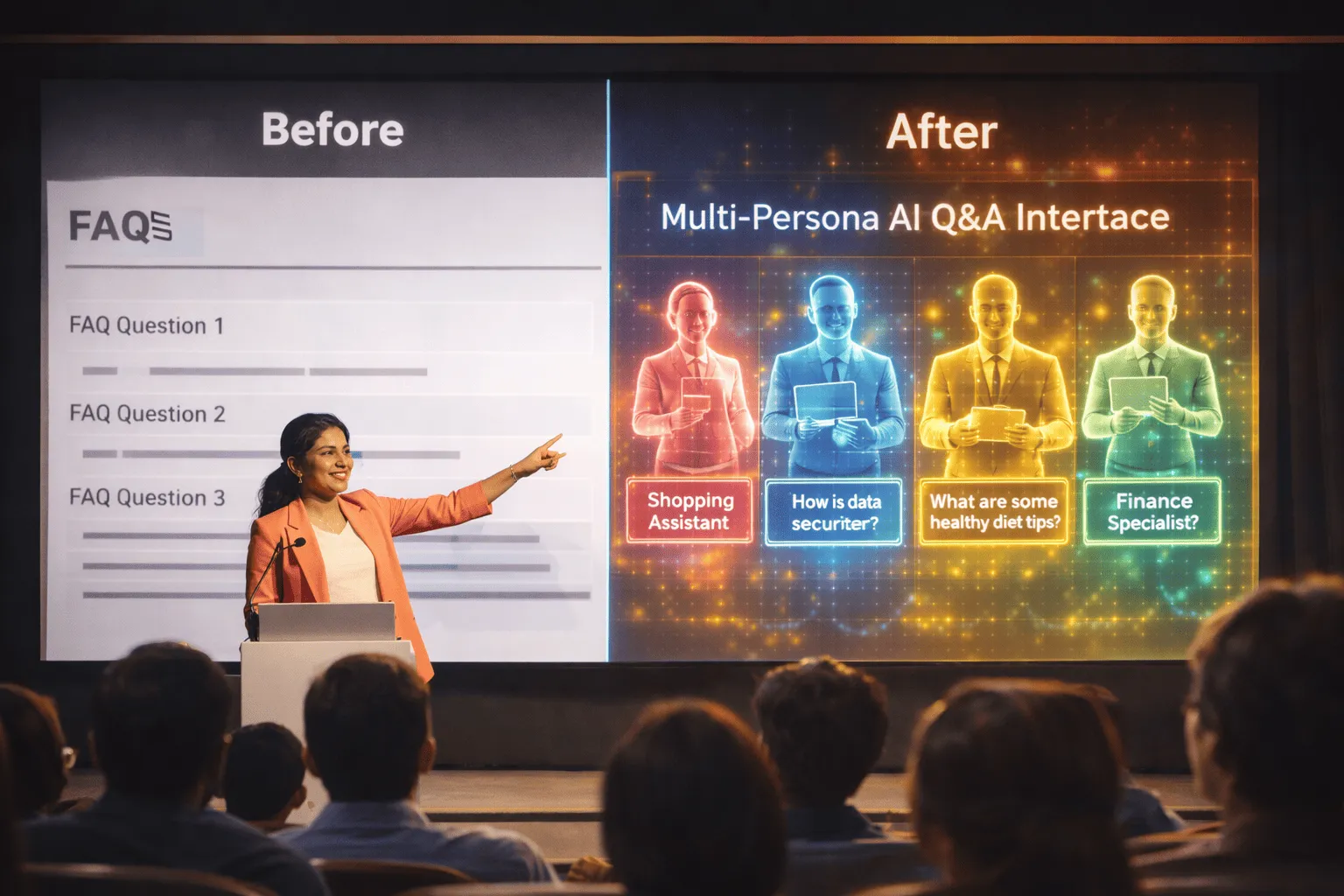
The way people ask questions has changed.
Not long ago, finding an answer meant searching, opening links, and scanning content. It worked, but it took effort.
Now, users expect something different.
They ask a question and expect a direct answer. Not a list of links. Not a long search process.
But even with this shift, something still feels missing.
Many answers are quick, but not always useful. They cover one angle and leave out the rest. Users end up asking again or looking elsewhere.
That’s where a Multi-Persona AI Platform for All Your Questions is starting to reshape the Q&A experience.
It doesn’t just provide answers. It improves how those answers are delivered and understood.
Q&A is no longer about single responses
Traditional Q&A systems focus on one response.
You ask something. You get one answer.
That approach has limits.
Real questions often have multiple angles.
A single answer can’t always cover everything.
A multi-persona system changes this.
It provides multiple perspectives in one interaction.
This makes answers more complete.
It reduces the need to re-ask questions
Re-asking is common.
Users try different versions of the same question just to get a better answer.
This takes time.
A Multi-Persona AI Platform for All Your Questions reduces this behavior.
By covering multiple perspectives upfront, it answers more of the user’s intent.
This keeps everything in one interaction.
It improves clarity in responses
Clarity is one of the biggest challenges in Q&A.
Answers can be too technical or too vague.
A multi-persona system improves this.
It offers different styles of explanations.
Users can pick what makes sense to them.
This reduces confusion.
It aligns with modern expectations
Users expect more than just answers.
They want:
Fast responses
Clear explanations
Relevant insights
This shift is influencing how AI Development Companies are building new systems.
Flexibility and adaptability are becoming essential.
A multi-persona approach fits this direction.
It makes interactions more natural
Traditional Q&A systems feel structured.
A multi-persona system feels more dynamic.
Different perspectives create variation.
This makes the interaction feel closer to a real conversation.
It supports deeper exploration
Q&A is not always a one-step process.
Users often want to explore further.
A multi-persona system supports this.
It provides multiple angles that users can build on.
This creates a richer experience.
It improves decision-making within Q&A
Many questions are linked to decisions.
Users want to compare options or understand trade-offs.
A multi-persona system helps by providing different viewpoints.
This makes it easier to evaluate choices.
It reduces dependency on multiple sources
Traditional Q&A often leads to multiple searches.
Users check different sources to confirm information.
A multi-persona system reduces this need.
It brings multiple perspectives into one place.
This saves time.
It supports different types of users
Not every user wants the same kind of answer.
Some prefer quick summaries.
Some want detailed explanations.
Some need examples.
A multi-persona system caters to all of them.
This improves the overall experience.
It simplifies complex questions
Some questions are complex.
They involve multiple factors.
A multi-persona system breaks them down.
Each perspective focuses on one aspect.
This makes complex queries easier to understand.
It enhances engagement
Engagement happens when users find value.
A multi-persona system increases value.
There’s more to explore.
Users can interact with different perspectives.
This keeps them engaged.
It improves confidence in answers
Confidence comes from understanding.
If users feel unsure, they keep searching.
A multi-persona system improves confidence.
By offering multiple viewpoints, it provides a more complete picture.
It supports learning within Q&A
Q&A is often used for learning.
A multi-persona system improves this.
It provides multiple explanations.
Users can explore and understand better.
It adapts to different contexts
The same question can mean different things in different contexts.
A multi-persona system handles this.
It presents multiple interpretations.
This increases relevance.
It integrates well with career-focused platforms
Q&A is widely used in career preparation.
For example, an AI Interview Platform can benefit from multi-persona responses by offering different ways to approach interview questions.
This improves preparation.
Why this shift matters now
User expectations are higher.
People want answers that are:
Quick
Clear
Flexible
Traditional Q&A systems struggle to meet all these needs.
A Multi-Persona AI Platform for All Your Questions addresses them more effectively.
A better way to ask and answer
At its core, this shift improves one thing.
The experience of Q&A.
From one answer to multiple perspectives.
From static responses to dynamic interaction.
From basic replies to meaningful understanding.
That’s what makes it different.
It doesn’t just answer questions.
It improves how those questions are experienced.
And that’s why it’s reshaping the Q&A experience.